
Jeff Blashill (ejected) and Petr Mrazek absolutely furious after late Jonathan Huberdeau goal allowed to stand following goalie interference review

Nation Sites
The Nation Network
WingsNation has no direct affiliation to the Detroit Red Wings, Ilitch Holdings, NHL, or NHLPA
WINGS POST-GAME: WHAT EVEN IS GOALTENDER INTERFERENCE!?
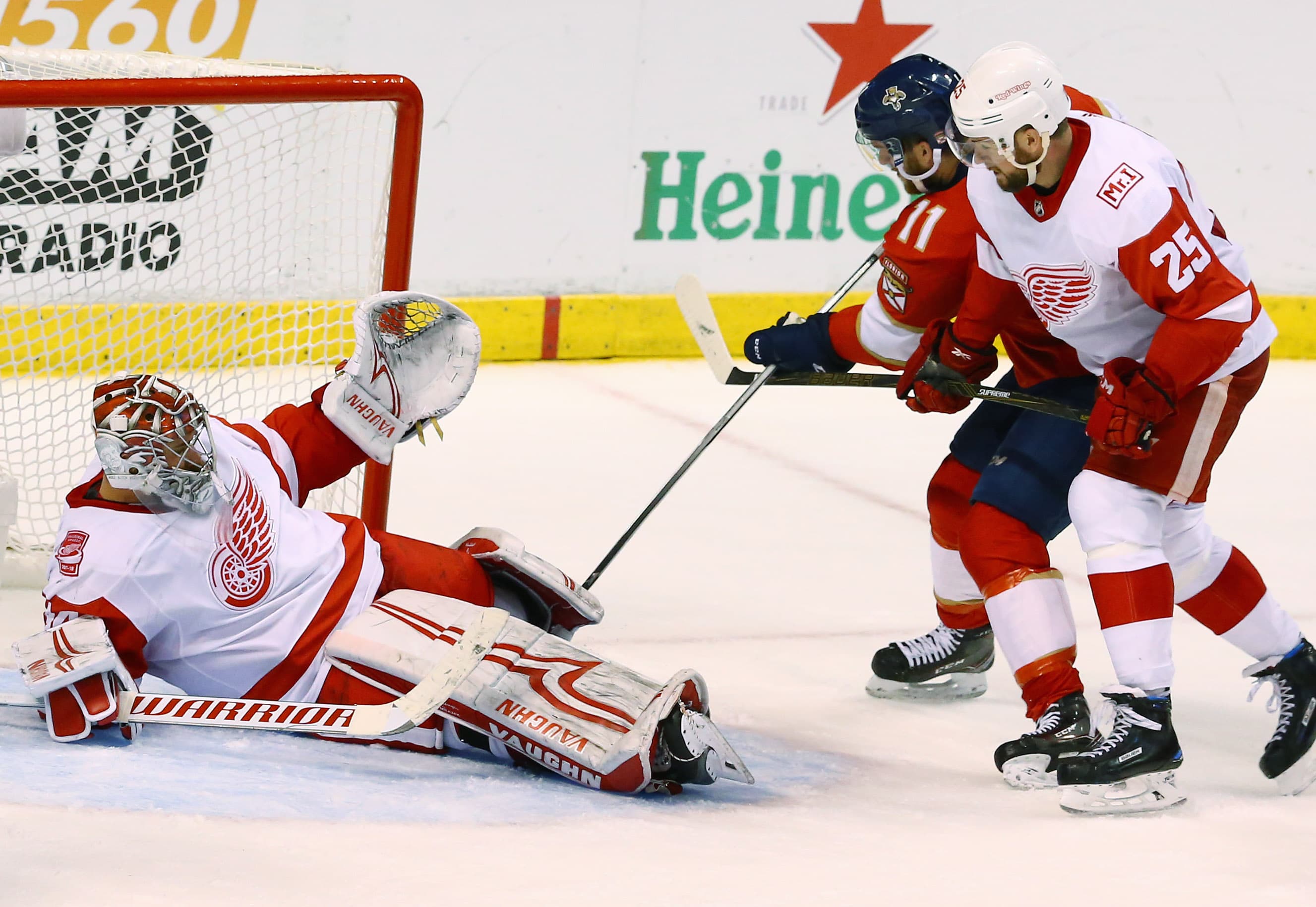
Photo credit: Robert Mayer-USA TODAY Sports

By Nick Seguin
Feb 4, 2018, 10:45 EST
At this point, we’re all familiar with the story. The Wings were in Florida last night and lost in spectacular fashion when Jonathan Huberdeau scored a goal in the dying seconds of the game. What was so spectacular about it? Huberdeau was in front of the net, knocked over Petr Mrazek in his crease, and slid the puck in while Mrazek was down.
Jeff Blashill, of course, challenged the play and was furious when the goal was upheld, sending the Panthers home with a 3-2 victory.
It stung more because the Wings were holding on to the game by a thread, having been out-attempted and out-shot badly at 5v5. Another ten seconds and they would have locked up at least one point. Maybe they would have even stolen the game and collected two against their division rivals.
So was it actually a goal? Let’s have a look at it first to provide some context:
There are a few things to point out right off the bat:
- Petr Mrazek is inside his crease
- Mike Green gently nudges Huberdeau into the crease.
- Both of Huberdeau’s feet are in the crease when contact is initiated.
- Huberdeau’s shoulder comes into contact with Mrazek’s head as Mrazek tries to move in his crease.
- Mrazek was not able to make a save due to being down on the ice as a result of this contact.
Based on these five points, does this constitute goaltender interference? The official NHL Rulebook‘s definition of “Interference on a Goalkeeper” (Rule 69) is below. I’ve highlighted the parts that are relevant to this play.
69.1 Interference on the Goalkeeper – This rule is based on the premise
that an attacking player’s position, whether inside or outside the
crease, should not, by itself, determine whether a goal should be
allowed or disallowed. In other words, goals scored while attacking
players are standing in the crease may, in appropriate circumstances
be allowed. Goals should be disallowed only if: (1) an attacking
player, either by his positioning or by contact, impairs the goalkeeper’s
ability to move freely within his crease or defend his goal; or (2) an
attacking player initiates intentional or deliberate contact with a
goalkeeper, inside or outside of his goal crease. Incidental contact
with a goalkeeper will be permitted, and resulting goals allowed, when
such contact is initiated outside of the goal crease, provided the
attacking player has made a reasonable effort to avoid such contact.
The rule will be enforced exclusively in accordance with the on-ice
judgement of the Referee(s), but may be subject to a Coach’s
Challenge (see Rule 78.7).
For purposes of this rule, “contact,” whether incidental or
otherwise, shall mean any contact that is made between or among a
goalkeeper and attacking player(s), whether by means of a stick or
any part of the body.
The overriding rationale of this rule is that a goalkeeper should
have the ability to move freely within his goal crease without being
hindered by the actions of an attacking player. If an attacking player
enters the goal crease and, by his actions, impairs the goalkeeper’s
ability to defend his goal, and a goal is scored, the goal will be
disallowed.
If an attacking player has been pushed, shoved, or fouled by a
defending player so as to cause him to come into contact with the
goalkeeper, such contact will not be deemed contact initiated by the
attacking player for purposes of this rule, provided the attacking player
has made a reasonable effort to avoid such contact.
Seems pretty clear to me. When Huberdeau’s shoulder comes into contact with Mrazek’s head, he’s impairing the goalkeeper’s ability to move freely within his crease. If the overriding rationale of the rule is that Mrazek should have the ability to move freely within his goal crease without being hindered by the actions of an attacking player, then there is plenty of rationale for calling goaltender interference.
Of course, there’s the argument that Mike Green shoved Huberdeau, causing him to come into contact with the goalkeeper. I don’t think this argument holds any weight, though. For one, Green didn’t cause Huberdeau to come into contact with Mrazek. He shoved Huberdeau into the crease, but the contact between Huberdeau and Mrazek was not a direct result of Green’s contact with Huberdeau.
There is another clause in the rule book that further clarifies what happens when contact takes place between an attacking player and a goaltender inside the crease:
69.3 Contact Inside the Goal Crease – If an attacking player initiates
contact with a goalkeeper, incidental or otherwise, while the
goalkeeper is in his goal crease, and a goal is scored, the goal will be
disallowed.
I don’t know, man. It doesn’t get any more obvious than that.
The NHL is under a lot of heat right now for these goalie interference calls. Despite it being clearly written out in the rulebook, nobody seems to know what goaltender interference even is anymore. It’s been brought on by a lack of consistency from the officials, who are not held accountable to give any sort of rationale or explanation as to how they interpreted the rule on a given play.
If you ask me, a video explanation from the league should be posted after the fact, providing the rationale for why a goal was called off or not. Similar to how the NHL Department of Player Safety has to provide rationale for why they decide to suspend a player. The problem is that the league and the officials are clearly not even on the same page when it comes to this rule. This was made clear by Gary Bettman’s comments at the All-Star Game about sending a memo out to the officials on how to better make these calls.
One thing is for certain, they need to figure this out fast. These blown calls are stealing important points away from teams who are fighting for a playoff spot. We’ve seen it happen in Toronto, Edmonton, and Winnipeg, where James Neal literally broke his stick over Connor Hellebuyk’s head and was not called for goalie interference.
Comments to the media and memos are not enough. The NHL needs to sit all of its officials down in a conference room and comprehensively take them through how to call this rule consistently. Otherwise, they are going to be hearing disappointing comments from coaches, players, media, and fans after games every night.
The Wings have already sounded off about the goal in Florida. Jeff Blashill was thrown out of a game for the first time of his career and I don’t think I’ve ever seen Petr Mrazek so angry. And he should be. He’s having a great stretch. That goal cost him another win. It could cost the Wings their season.
The controversial goal has also overshadowed the fact that Danny DeKeyser scored both Red Wings goals, giving him three goals in two games. It’s a nice little stretch for the Wings’ highly paid defenseman who’s frequently under attack by the fanbase.
NEXT UP
The Wings will host the Boston Bruins on Tuesday night. Puck drop is 7:30 P.M. ET and you’ll be able to watch the game on Fox Sports Detroit or NESN if you’re tuning in from the Boston area. As always, Brock Seguin will have your post-game early Tuesday afternoon.


Breaking News
- Handing out even more team awards to the 2021–22 Detroit Red Wings
- Three former Red Wings draft selections are set to hit free agency
- Report: Detroit Red Wings captain Dylan Larkin switches agents
- Why Detroit Red Wings defenceman Moritz Seider should win the Calder Trophy
- Cossa remains sharp as Oil Kings push Winnipeg to the brink in WHL playoffs

Detroit Red WingsTeam Cap Summary
Cap Summary
2026-27
2027-28
Projected Cap Hit
$84,427,916
$50,266,250
Projected Cap Space
$19,572,084
$63,233,750
Current Cap Space
$19,572,084
$63,233,750
Active Players
22/23
13/23
Draft Picks
Round
'26
'27
1
1
1
2
1
0
3
1
1