
Nation Sites
The Nation Network
WingsNation has no direct affiliation to the Detroit Red Wings, Ilitch Holdings, NHL, or NHLPA
Looking back at the 1936-37 Detroit Red Wings season


Aug 7, 2016, 15:19 EDTUpdated:

Photo via Hockey Hall of Fame
Starting earlier this week with an article on the 1935-36 Red Wings, we’re going back through every Wings team in history that won the Stanley Cup.
1936-37 was a fun year for the Wings. Winning the Cup the year earlier, Detroit had solidified its place in the NHL and the city had a population around 1.5 million, just under its peak population of 1.86 million in 1950.
Though the Great Depression in the late 1920s was still having a major impact to the auto industry in the area, the back-to-back Stanley Cups in the mid 1930s helped to bring some positive change to the Detroit area. Though the Wings (and the NHL) were not nearly as popular back then as they were today and the team was often overshadowed by the other professional teams in the city, the 1937 Wings helped to pave the way for hockey in Detroit and Michigan as a whole.
Results
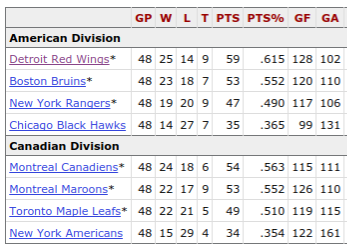
Stats via Hockey Reference
The Wings were, all things considered, the best all-around team in the league.
With the league’s most goals for, least goals against and most points, the Wings edged ahead of the other playoff teams in what was ultimately a pretty tight league, and were in all likelihood, the favourites to win the Cup once playoff time came around. They weren’t far and away overly dominant as they really won 25 games and didn’t win 23, but were just good enough to be better than everyone else, and really, that’s all that matters.
Season Recap
Coached at the time by the one and only Jack Adams, the Wings had a relatively routine season, winning no more than four games in a row at a time and only scoring more than four goals in a game five times. But 31 of their games saw them allow two goals or less, as sound defence pushed them right to the top of the standings. They also beat Boston seven times out of eight, which definitely helped.
Normie Smith played all 48 games in goal for the Wings, picking up six shutouts, a league best 2.05 GAA and the Vezina trophy in the process.
Here’s a chart I made up showing how each game went for the Wings that year:
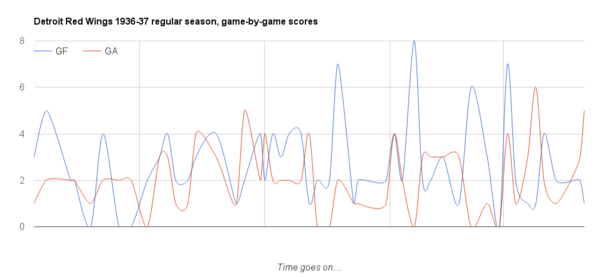
Yeah, it’s kind of all over the place, just like the NHL was at that point in time. There wasn’t anyone overly dominant in the league, and the Wings just so happened to be good enough to win more games than they lost, but didn’t really show any stretches of utter dominance.
The Wings were actually 1-4-1 against the Canadiens in their regular season series, but due to a rather strange seeding system, both teams received a bye to the semifinal of the playoffs where they faced… each other.
The semifinal
Weird playoff seeding aside, the Wings had themselves a challenge in front of them facing a team they hadn’t had much luck with in the semi-finals. Hosting the first two games of the series before going back to Montreal for the final three games of the best-of-five series if needed, the Red Wings really needed to get off on the right track if they wanted any hope of winning the series.
And boy, did they come out firing. After not being overly dominant all year long yet still being powerful, the Wings came up with one of the best playoff performances they could find. They scored nine goals over the two games at home and Montreal scored… one. A 4-0 win in game one and a 5-1 win in game two pushed the Wings needing just a sole victory to claim a berth in a second consecutive Stanley Cup Final.
Of course, they wouldn’t make things that easy. Heading back to the Montreal Forum, the Wings suffered back-to-back 3-1 losses and found out this whole home-ice advantage thing was kind of important.
Game five in Montreal was for all the marbles, or at least the chance to keep going.
As you probably figured because you’re reading this now, the Wings won. The method, however, wasn’t so easy.
The Wings and Habs went to overtime tied 1-1, with the next goal deciding the series. A first overtime solved nothing. So did a second. But a third overtime proved the decider, with the Wings pulling through to the final with a 2-1 win with a goal from Hec Kilrea.
Normie Smith, however, was out for the rest of the playoffs. An elbow initially hurt in game three against the Canadiens, proved to be a nagging injury and Smith was ruled out for the rest of the playoffs.
Smith was initially replaced by 22-year old Jimmy Franks.
Unhappy with the play of Franks or perhaps just looking for something better, the Wings went with 26-year old Earl Robertson for the final, who made his NHL debut during those playoffs.
(Franks played just 30 minutes in the playoffs, in that game three loss where he gave up a pair of goals. He played one game for the Wings the following season, and would not make the NHL again until 1942-43, where he would play with the New York Rangers. In 1943-44, he later returned to the Red Wings, where he played 17 more games for them.)
It’s unclear exactly when Smith was fully out, but deduction shows that he must have either been introduced in game four or five of the semifinal. Smith played part or all of the five games, but was unfit once the team had qualified for the final to continue.
The Final
Starting his first ever NHL game in game one of the Stanley Cup Final, Robertson was probably having the most difficult time of his life. To make matters more interesting, it was in Madison Square Garden. Talk about a challenge.
Legendary coach Lester Patrick lined up on the other bench against Jack Adams. A pair of players with awards named after them makes them a pair for the ages, already.
Robertson and the Wings crumbled under the pressure, at least initially. The mighty Wings were blown out 5-1 by the Rangers, and things didn’t look great.
Thankfully for Detroit, the famous Barnum and Bailey Brothers circus was in town, forcing the Rangers out of their home stadium, and giving the Wings home ice for the final four games of the best-of-five final, if necessary.
Spoiler: It was necessary.
A 4-2 win in game two rid Detroit of their game one demons, but a stagnant offence in game three mixed with Dave Kerr’s fourth shutout of the playoffs was the cause of a 1-0 loss.
Needing two wins over the final two games to clinch the Cup was no easy task, but still achievable.
Looking to play hero, Earl Robertson took Normie Smith’s crease and made it his own. He posted back to back shutouts in games four and five, and Detroit pushed themselves to the top of the hockey world again for a second consecutive year.
Sources:
Stanley Cup Fever, Brian McFarlane
NHL.com
Hockey-Reference.com


Breaking News
- Handing out even more team awards to the 2021–22 Detroit Red Wings
- Three former Red Wings draft selections are set to hit free agency
- Report: Detroit Red Wings captain Dylan Larkin switches agents
- Why Detroit Red Wings defenceman Moritz Seider should win the Calder Trophy
- Cossa remains sharp as Oil Kings push Winnipeg to the brink in WHL playoffs
Detroit Red WingsTeam Cap Summary
Cap Summary
2026-27
2027-28
Projected Cap Hit
$84,427,916
$50,266,250
Projected Cap Space
$19,572,084
$63,233,750
Current Cap Space
$19,572,084
$63,233,750
Active Players
22/23
13/23
Draft Picks
Round
'26
'27
1
1
1
2
1
0
3
1
1